How Many Snacks a Day Is Actually Normal?
Quick Answer: There is no universal number, and the research does not support one. Most people land naturally at one to three snacks a day, and the count matters far less than whether each snack is doing a job. A useful test: if you are genuinely hungry at the time, and you are not still hungry an hour later, the snack was doing something. If neither is true, you are eating out of routine, boredom, or availability — and that is the variable worth changing, not the number.
You had a snack at 10, another at 3, something at 9 while watching something, and now you are wondering whether normal people do this.
They do. Research on eating frequency has repeatedly failed to find a magic number — three meals is not superior to six, and grazing is not superior to fasting windows, once total intake is matched. What that means practically is that the useful question is not how many, but what each one is actually for. The signal in the third section is the fastest way to tell.

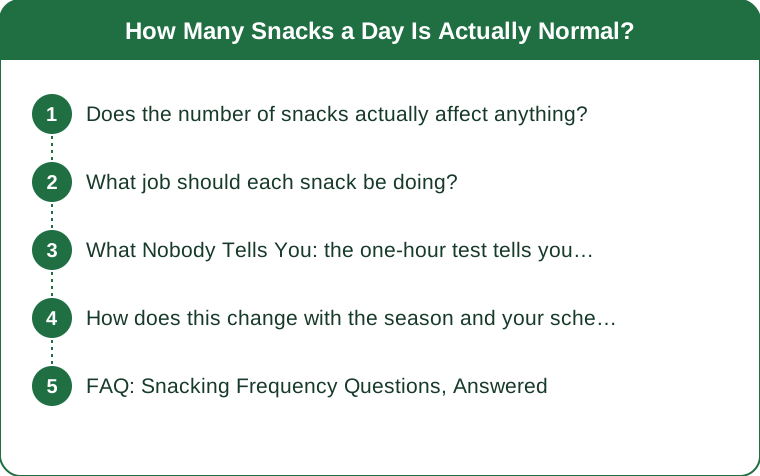
Does the number of snacks actually affect anything?
Less than the food industry and diet culture both suggest.
The claim that frequent small meals boost metabolism has not held up. The thermic effect of food — the energy used digesting it — scales with how much you eat, not how many sittings you split it across. Six 400-calorie meals and three 800-calorie meals produce essentially the same metabolic cost.
The claim that fewer meals is inherently better has also not held up for most outcomes. Some people do well with a compressed eating window; others get shaky, irritable, and end up overeating in the evening.
What the evidence does support is that snack quality and context matter substantially. Snacking is associated with higher total intake mainly when the snacks are highly palatable, low in protein and fiber, and eaten while distracted. The same number of snacks made of yogurt, fruit, nuts, or eggs shows a very different pattern.
So the honest answer to how many: whatever number keeps you from arriving at meals ravenous, and does not push your total intake past what you need. For most people with a conventional schedule, that is one to three.
What job should each snack be doing?
Every snack that earns its place is doing one of four things.
Bridging a long gap. If lunch is at noon and dinner is at 8, that is an eight-hour stretch, and a mid-afternoon snack prevents the arrive-home-and-eat-everything pattern. This is the highest-value snack in most people’s day.
Fueling or recovering from activity. Before or after training, as covered by the usual rules — carbohydrate ahead, protein and carbohydrate after.
Filling a genuine nutritional gap. If you do not hit your protein or fiber target through meals, a snack is an easy place to put a portion of it. Cottage cheese, edamame, a pear with nut butter.
Managing a blood sugar or medical need. For people with diabetes or reactive hypoglycemia, scheduled snacks are functional, not optional, and should follow their clinician’s guidance rather than general advice.
If a snack is not doing one of these four, it is almost certainly doing a fifth thing: providing a break, a reward, or something to do with your hands. That is not a moral failing and it does not need to be eliminated — but naming it accurately is what lets you decide whether food is the right tool for it.

What Nobody Tells You: the one-hour test tells you everything
Forget counting. There is a single test that sorts useful snacks from filler, and it takes one hour.
Eat the snack. Set a mental marker. Check in an hour.
If you are comfortably not thinking about food, the snack worked. It had enough protein, fat, or fiber to actually change your hunger state.
If you are hungry again — or worse, hungrier than before — the snack was mostly fast carbohydrate. It raised blood glucose, triggered an insulin response, and left you at or below where you started. This is why a granola bar at 3pm often leads directly to a second snack at 4, and a handful of almonds does not.
The composition that passes the test reliably: at least 7 to 10 g of protein, or a combination of protein and fiber, in roughly a 150 to 250 calorie package.
Things that pass: Greek yogurt. A hard-boiled egg with fruit. Cottage cheese. Edamame. Apple with peanut butter. A slice of cheese with whole grain crackers. Roasted chickpeas.
Things that reliably fail: most granola bars, crackers alone, pretzels, dried fruit alone, fruit juice, and anything marketed on being low fat.
There is a second, quieter version of the test worth running: were you actually hungry when you started? Try drinking a glass of water and waiting ten minutes. Real hunger persists. Boredom and thirst usually do not, and the difference becomes very easy to feel after a week of checking.
How does this change with the season and your schedule?
It changes more than people expect, and right now is one of the shifts.
As daylight shortens through late summer into fall, appetite patterns move. Afternoon cravings tend to intensify and shift earlier as the light fades sooner, and the pull toward warmer, denser food increases. This is a normal seasonal response, not a loss of discipline, and fighting it with the same summer snack you have eaten since June often just means eating it twice.
Practical adjustments: move the afternoon snack half an hour earlier as the light changes. Swap cold snacks for warm ones — a mug of broth, warm oats, roasted nuts — which satisfy differently and register better. And be slightly more generous with protein in that afternoon slot as activity levels typically drop.
Schedule matters as much as season. Someone eating dinner at 6 needs fewer snacks than someone eating at 9. A late dinner household almost always benefits from a real afternoon snack rather than pretending otherwise and then eating for two hours after dinner.
FAQ: Snacking Frequency Questions, Answered
Is snacking after dinner always a bad idea?
No. A small evening snack is unproblematic for most people, and for those who eat dinner early or train hard, it prevents overnight hunger. The pattern that causes trouble is unstructured evening eating in front of a screen, which is less about the timing and more about the absence of any endpoint.
Should I stop snacking to lose weight?
Only if the snacks are pushing your total intake above where you want it. Cutting a snack that was preventing an oversized dinner usually backfires. Look at the whole day rather than removing a slot on principle.
How do I stop snacking out of boredom at my desk?
Change the friction rather than your willpower. Keep the default snack in a drawer that requires standing up, keep water within reach, and take a two-minute walk when the urge appears. Most desk snacking is a request for a break wearing a costume.
TL;DR:
- There is no correct number — one to three a day is where most people naturally land.
- Every snack should be bridging a gap, fueling activity, filling a nutrition gap, or meeting a medical need.
- Run the one-hour test: still satisfied means it worked; hungry again means it was fast carbohydrate.
- Aim for 7 to 10 g of protein per snack, and move the afternoon one earlier as the daylight shortens.
Stop counting and start checking. One useful snack beats three that leave you exactly where you started.
Keep Reading
This article is for general informational purposes only and is not medical advice. Always consult a qualified health professional for guidance specific to you.