How to Tell Real Hunger From the Four Things That Imitate It
Quick Answer: Physical hunger builds gradually, is felt in the body rather than the mind, is open to any food, and does not disappear if you wait. The four imitators are thirst, tiredness, boredom and habitual cueing - and each has a tell. Thirst improves with a glass of water within ten minutes. Tiredness produces cravings for fast carbohydrate specifically. Boredom vanishes the moment something interesting happens. Habit is time-and-place-locked and disappears if you change rooms.
You were not hungry at three o’clock. You were at your desk at three o’clock.
Those two things have felt identical for so long that they became the same signal.

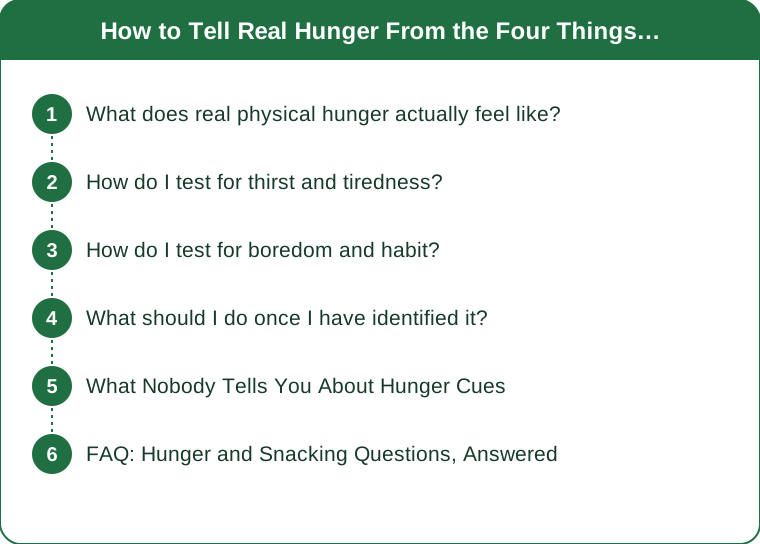
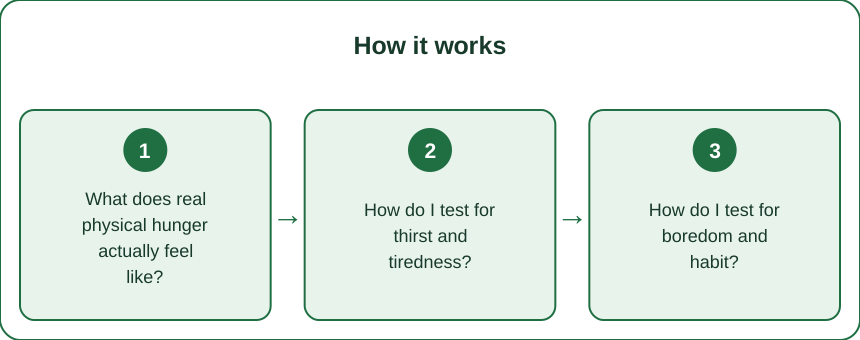
What does real physical hunger actually feel like?
It builds gradually over 20 to 30 minutes rather than arriving suddenly and fully formed.
It is felt in the body - stomach, and sometimes low energy or slight irritability - rather than as a thought about a specific food.
It is food-neutral. Genuine hunger makes plain food appealing; a craving is specific and often insists on one texture.
It does not go away if you wait ten minutes. It intensifies, which is the single most useful diagnostic available.
It correlates loosely with time since eating, which sounds obvious and is worth checking, because people frequently feel hungry ninety minutes after a full meal.
Satiety signals are slower than hunger signals, which is why eating quickly overshoots. This is general information, not medical advice.
How do I test for thirst and tiredness?
Thirst: drink a glass of water and wait ten minutes. If the sensation reduces noticeably, it was at least partly thirst.
This is not a myth about confusing the two signals so much as the practical observation that mild dehydration produces vague low-level discomfort that people learn to interpret as hunger.
Autumn makes this worse, because people drink less water as the weather cools while indoor heating dries the air.
Tiredness: check what you want, not how much. Fatigue produces cravings for fast carbohydrate and sugar specifically, because the body is looking for quick energy.
If you would happily eat chicken and vegetables, you are probably hungry. If only biscuits will do, tiredness is a strong candidate.
Poor sleep affects appetite regulation, with research linking short sleep to changes in appetite hormones and increased intake the following day.
How do I test for boredom and habit?
Boredom: change activity for ten minutes. Not a screen - stand up, go outside, make a phone call, do one task.
If the hunger disappears entirely, it was boredom, which is not a moral failing and is one of the most common eating triggers in remote and desk-based work.
Boredom hunger has a searching quality - opening the fridge, closing it, opening the cupboard. Real hunger does not shop around.
Habit: check the clock and the location. Habitual hunger is time-and-place locked, arriving at 3pm at the desk or at 9pm on the sofa, regardless of what you ate.
Change the room and see what happens. Habit cues are highly context-dependent, and stepping into a different space frequently dissolves them.
Habit is the hardest of the four to notice precisely because it is consistent, and consistency feels like a real signal.

What should I do once I have identified it?
If it is hunger, eat something with protein. Waiting it out is not a virtue and usually leads to a larger, faster, less considered meal later.
If it is thirst, drink and continue. Then check whether your baseline water intake dropped when the weather changed.
If it is tiredness, address the tiredness where you can - a short walk, daylight, or accepting that today is a lower-energy day and eating a proper meal rather than grazing.
If it is boredom, the answer is rarely food and is often movement. Ten minutes outside works remarkably well and takes less time than the snack does.
If it is habit, change the cue rather than fighting the urge. Move where you sit, put the snack somewhere less convenient, or deliberately replace it with a different two-minute ritual.
And none of this means never snacking. A planned snack is a normal part of eating - the goal is knowing which one you are having. This is general information, not medical advice.
What Nobody Tells You About Hunger Cues
Undereating earlier in the day is the most common cause of late-day snacking, and it is almost always diagnosed as a willpower problem instead. A small breakfast reliably produces a 4pm that feels like a character flaw.
Restricting a specific food increases its salience, which is why the food you have decided not to eat is the one that shows up in every craving. This is well documented and is not a personal failing.
Hunger is not a smooth curve. It comes in waves, and an unattended wave often passes and returns - which is why waiting ten minutes is diagnostic rather than a test of endurance.
Menstrual cycle phase affects appetite measurably for many people, with increases commonly reported in the luteal phase. Interpreting a predictable monthly increase as a lapse is both common and inaccurate.
Seasons change appetite too. Many people eat more as daylight decreases in autumn, and treating September’s appetite as a failure to maintain August’s habits sets up a frustrating few months.
Eating while distracted reduces how much you register eating, and people who eat lunch at a screen are more likely to snack afterwards - which makes the desk lunch a double cost.
And chronic dieting blunts hunger cues over time, which is why the advice to simply listen to your body works poorly for people who have spent years overriding it. Rebuilding those cues takes months, not days. If you have a complicated relationship with eating, this is worth discussing with a healthcare professional.
FAQ: Hunger and Snacking Questions, Answered
How long should I wait to test whether it is real hunger?
Ten minutes is enough for most of the tests. Real hunger will still be there and usually stronger; boredom and habit frequently dissolve.
Is it bad to snack between meals?
No. Planned snacks are a normal part of many eating patterns. The question is whether it is a choice or an automatic response to a cue.
Why am I hungrier in the afternoon?
Commonly because breakfast and lunch were too small or too low in protein, plus a natural energy dip, plus habit. Look at what you ate before 2pm before looking at your willpower after it.
Does drinking water before meals help?
Some research suggests a modest effect on intake, and it is harmless to try. It is more useful as a diagnostic than as a strategy.
What is the best kind of snack if I am genuinely hungry?
Something with protein and some fibre - yoghurt, nuts, fruit with nut butter, cheese and oatcakes. It holds better than something sugar-only and does not create a second dip an hour later.
Should I be worried if I am hungry all the time?
Persistent excessive hunger, especially with other changes such as weight loss, thirst or fatigue, is worth discussing with a healthcare professional. This is general information, not medical advice.
TL;DR:
- Real hunger builds gradually, is body-based, is open to any food, and does not fade after ten minutes.
- Thirst: drink a glass of water and wait ten minutes.
- Tiredness: check what you want - fatigue asks specifically for fast carbohydrate.
- Boredom: change activity for ten minutes and see if it survives.
- Habit: check the clock and the room, then change the room.
- Late-day snacking is usually caused by undereating earlier, not by weak willpower.
The point is not to snack less - it is to know which of the five you are answering. This is general information, not medical advice.
Keep Reading
This article is for general informational purposes only and is not medical advice. Always consult a qualified health professional for guidance specific to you.