Why the Snack You Packed Is Never the One You Want by 3pm
Quick Answer: You pack snacks in a morning state — rested, unhurried, not hungry — and eat them in an afternoon state that is tired, depleted, and craving something entirely different. Morning-you optimises for virtue and variety; afternoon-you wants density, salt or sweetness, and immediacy. Packing two components rather than one finished snack closes most of the gap.
The carrot sticks looked reasonable at 7am. At 3pm they look like a punishment, and the vending machine looks like a friend.
This is not a willpower failure. It is a fairly reliable mismatch between two different versions of you.

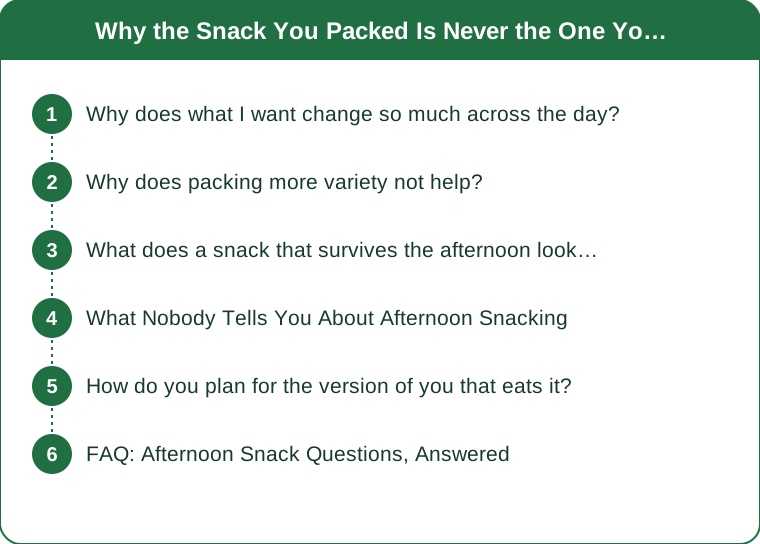
Why does what I want change so much across the day?
Because appetite is state-dependent, and the states are genuinely different.
At 7am you are rested, your blood sugar is stable, and you have had a night of not eating. Hunger is low or absent, and food choices are made abstractly — you are choosing what a sensible person should eat, not what you want, because you do not currently want anything.
By 3pm several things have shifted. You have been awake for eight hours, made a large number of decisions, probably eaten a lunch that was smaller than you registered, and are somewhere in the mid-afternoon dip when alertness naturally falls.
In that state, the body preferentially seeks energy density and immediate reward — which is exactly what raw vegetables and plain rice cakes do not provide.
There is also a plain sensory issue. Morning-you selects with your eyes; afternoon-you responds to texture and salt and sweetness. A snack chosen for how it looks in a container rarely satisfies on the dimensions that matter later.
Why does packing more variety not help?
Because the problem is not choice, it is that none of the options match the state.
People respond to the mismatch by packing three snacks instead of one, and typically report that they eat none of them and buy something else anyway. Three virtuous options in the wrong category is still zero options in the right one.
What actually predicts whether a packed snack gets eaten is not variety but density and salt-or-sweet presence.
A useful reframe: instead of asking ‘what should I eat at 3pm’, ask ‘what do I actually buy when I do not have anything packed’. That answer — usually something salty and crunchy, or something sweet and dense — is the target you need to hit with a packed version.
Matching the category rather than fighting it is the whole strategy. Someone who reliably buys crisps is not going to be satisfied by grapes, but might well be satisfied by salted nuts, roasted chickpeas, or popcorn. Someone who reliably buys chocolate does far better with dates and nut butter than with an apple.
What does a snack that survives the afternoon look like?
Four properties, and the more of them present, the higher the odds it gets eaten.
Density. Something that delivers real energy in a small volume. Nuts, nut butter, cheese, dried fruit, oat-based bars. Water-heavy foods do not satisfy an afternoon dip regardless of how healthy they are.
Salt or sweetness, unapologetically. The craving is real and suppressing it usually costs more later. A salted or sweet element in the packed snack means the vending machine has less to offer.
Texture contrast. Something crunchy alongside something soft. This is why a single-texture snack — a smoothie, a plain bar, sliced fruit — fails more often than a combination.
Protein or fat. Not for virtue but for duration. A carbohydrate-only snack lifts you for forty minutes and drops you into a second dip before you leave.
The practical version: pack two components rather than one finished snack. Nuts plus dried apricots. Cheese plus oatcakes. Dark chocolate plus almonds. Two components hit more of the four properties than any single item, and the combination lets you respond to whichever craving actually shows up.

What Nobody Tells You About Afternoon Snacking
The 3pm dip is partly circadian and happens whether or not you ate lunch. There is a genuine dip in alertness in the early-to-mid afternoon that exists independently of food. Eating cannot fix a circadian dip, which is why a snack sometimes fails to help at all — and why a ten-minute walk sometimes works better than anything you could eat.
Lunch size predicts afternoon cravings more than snack quality does. A lunch that was smaller than it looked — a salad with no substantial protein, or a sandwich eaten at a desk while working — reliably produces a 3pm craving that no snack will fully satisfy. The intervention that works is at lunch, not at three.
Dehydration presents as a snack craving. Not as often as internet advice claims, but often enough to be worth ruling out. If a glass of water resolves it within ten minutes, it was thirst.
Boredom and task-avoidance are common triggers, and they are not solved by better snacks. If the craving reliably appears at the point of the day when your work becomes tedious, that is information about the work.
Snacking while working substantially reduces satisfaction. Food eaten without attention does not register properly, and people who eat a packed snack at their desk while typing frequently report being hungry again shortly afterwards. Five minutes away from the screen makes the same snack work better.
The snack you pack for a bad day should be different from the one you pack for a good day — and most people pack for the good day every time.
How do you plan for the version of you that eats it?
The practical changes that make packed snacks actually get eaten:
Pack at night, not in the morning. Evening-you is closer to afternoon-you in state — tired, appetite present, less aspirational. Snacks packed at 9pm are consistently more realistic than those packed at 7am.
Keep a fixed emergency option in the desk drawer. Not something you have to decide about. A jar of nuts, a few dark chocolate squares, some oatcakes. The whole point is removing the decision at the moment when decisions are expensive.
Pack for the craving you know you get. If it is salt, pack salt. Fighting the category is the most common reason packed snacks come home uneaten.
Front-load the day. A more substantial breakfast and a lunch with real protein reduces the intensity of the afternoon dip more than any snack strategy does.
Give yourself a real snack rather than a token one. A snack that leaves you slightly unsatisfied usually leads to a second thing thirty minutes later, and the two together are more than one adequate snack would have been.
And worth saying plainly: wanting a proper snack in the afternoon is normal, not a failure of discipline. A long gap between lunch and dinner is the situation snacks exist for, and treating a mid-afternoon snack as something to be resisted is a large part of why it ends up as something bought in a hurry rather than something planned. This is general information, not nutritional advice.
FAQ: Afternoon Snack Questions, Answered
Is it better to skip the snack entirely?
For some people, yes — if lunch was substantial and dinner is at a reasonable hour, no snack is a perfectly reasonable pattern. For most people with a six-hour or longer gap, a planned snack produces a calmer evening and a better dinner than arriving home very hungry.
Why do I want something sweet specifically?
A mid-afternoon preference for sweetness is extremely common and probably reflects a mix of falling blood glucose after a carbohydrate-heavy lunch, the alertness dip, and learned association. Pairing sweetness with protein or fat — dates with nut butter rather than dates alone — tends to satisfy it more durably than either alone.
How much should an afternoon snack actually be?
Enough to bridge to dinner rather than to replace it. Roughly 150-250 calories with some protein or fat works for most people; much less tends to trigger a second snack, and much more affects appetite at dinner.
TL;DR:
- Morning-you packs for a state you will not be in; afternoon-you is tired, depleted, and wants density and salt or sweetness.
- Variety does not help — three snacks in the wrong category is still nothing you want.
- Aim for density, salt or sweetness, texture contrast, and some protein or fat; pack two components rather than one item.
- Pack at night, keep a fixed emergency option in the drawer, and pack for the craving you actually get.
- Lunch size predicts afternoon cravings more than snack quality — the real fix is often earlier in the day.
The most useful shift here is giving up on the idea that the afternoon craving is something to be defeated. It arrives on schedule, it is largely predictable, and the people who eat well through it are almost never the ones with the strongest resolve — they are the ones who packed something they actually wanted.
Keep Reading
This article is for general informational purposes only and is not medical advice. Always consult a qualified health professional for guidance specific to you.