Why Cold Snacks Satisfy Differently Than Room-Temperature Ones
Quick Answer: Cold food tastes less intensely — cold suppresses both sweet perception and aroma — so you often eat more of it before feeling satisfied. Cold also slows eating slightly and produces a distinct refreshing sensation that can substitute for a genuine hunger signal, which is why a cold snack sometimes feels like enough when it is not, and sometimes feels like nothing when it should have been plenty.
A cold apple and a room-temperature apple contain identical calories and identical fiber. They do not do the same job at 3pm, and the difference is not in your head.
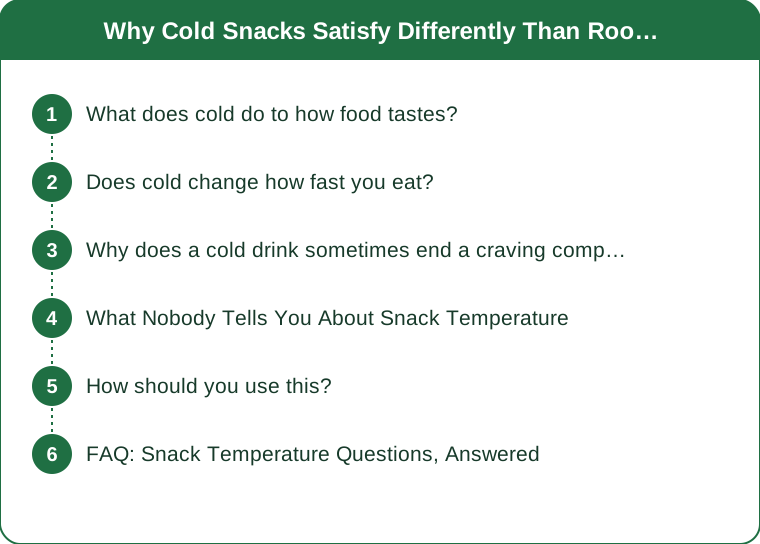
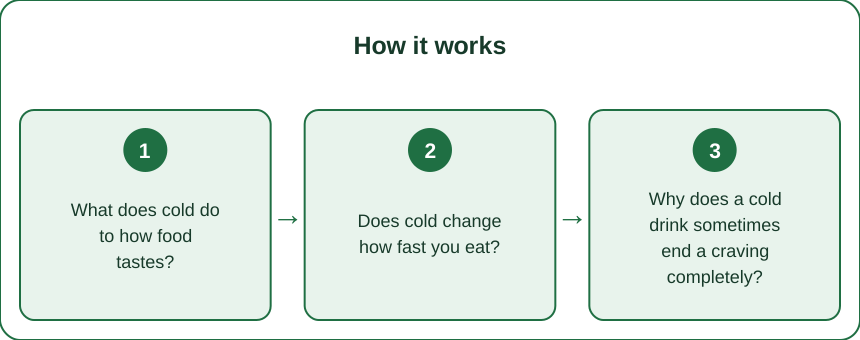
What does cold do to how food tastes?
It turns the volume down on the two channels that most drive satisfaction.
Sweetness perception drops. The receptors that detect sugar are temperature-dependent and respond less strongly in the cold. The same yogurt tastes noticeably sweeter after sitting out for ten minutes than it does straight from the fridge, with no change in composition.
Aroma drops harder. Most flavor is smell, and smell requires volatile compounds actually escaping the food into the air. Cold food releases far fewer of them. A cold peach smells like almost nothing; a warm one perfumes the room.
This matters because flavor intensity is one of the inputs into feeling satisfied. There is decent evidence that stronger-tasting food produces a satisfaction signal on less volume — the mouth registers that something substantial happened. Muted food does not send that signal as strongly, and the common outcome is eating more of it.
So the practical consequence: cold snacks tend to be under-tasted, and under-tasted snacks tend to be over-eaten. The classic case is straight-from-the-fridge cheese and crackers, where the cheese is contributing a fraction of its potential flavor and you end up going back for more of it.
The reverse case is real too. When you are not actually hungry and just want a mouth-feeling, cold delivers a strong sensory event with very little flavor — which is exactly why cold water or an ice pop satisfies a fidgety craving that has nothing to do with hunger.
Does cold change how fast you eat?
Yes, and this is where cold quietly works in your favor.
Very cold food has to be eaten more slowly. You take smaller bites, you hold them differently, and there is a natural pause between mouthfuls because the cold is a mild sensory event on its own. Anyone who has tried to eat ice cream quickly knows the ceiling exists.
Speed matters a lot for satiety. The hormonal signals telling your brain that food has arrived take roughly fifteen to twenty minutes to register, which means anything eaten in under five minutes is effectively eaten before your body has a vote. A snack that takes ten minutes to get through is much more likely to actually register than the same snack inhaled in ninety seconds.
This is why the temperature effect cuts both ways depending on the food:
- Cold, hard, and requiring work — a cold apple, cold carrots, frozen grapes, cottage cheese eaten with a small spoon — slows you down enough that the slowing outweighs the flavor suppression.
- Cold, soft, and easy — yogurt drinks, smoothies, ice cream — combines flavor suppression with fast consumption, which is close to the worst combination for feeling satisfied per calorie.
Frozen grapes are the interesting example. They are less sweet than room-temperature grapes because of the cold, but they take about four times as long to eat, and most people find a small bowl of them genuinely satisfying in a way the same grapes at room temperature are not.
Why does a cold drink sometimes end a craving completely?
Because a lot of afternoon snack urges are not hunger, and cold addresses the thing they actually are.
Three distinct signals get confused with each other in the mid-afternoon:
Actual hunger. Stomach signals, a real energy gap, usually four or more hours since eating. Cold water does nothing for this and the urge comes right back.
Thirst. Genuinely mistaken for hunger more often than people expect, and more common in late summer when fluid losses are higher. Cold water resolves it in about ten minutes, and the tell is that the craving fades rather than getting louder.
A stimulation gap. You are bored, or task-switching, or have been staring at a screen for two hours and your brain wants a change of state. Cold is an extremely effective state change — the sensory jolt is exactly what was being sought, and the food was never the point.
The practical test is cheap: drink something cold and wait ten minutes. If it was thirst or a stimulation gap, the urge dissolves. If it was hunger, you will still be hungry and now you know, which means you can eat something with protein in it instead of grazing.
This is not a trick to avoid eating. It is a way to find out what you are actually asking for, so the response fits. Answering hunger with cold water is just delaying a snack you will eat later and worse.
What Nobody Tells You About Snack Temperature
Warm snacks feel like meals; cold snacks feel like snacks. This is a categorization effect, and it is surprisingly strong. The same amount of the same food, warmed, is more likely to register psychologically as “I ate” — and the psychological registration influences whether you go looking for more an hour later. A cup of warm soup and a cold sandwich of equal calories do not leave the same impression.
Fat tastes different cold. Fat carries flavor and contributes mouthfeel, and cold fat is firmer and releases its flavor compounds more slowly. This is why cold pizza is a genuinely different food from hot pizza, and why cheese eaten straight from the fridge underdelivers so consistently. Twenty minutes on the counter changes cheese more than any other common snack food.
Cold blunts salt less than it blunts sweet. Salty snacks lose relatively little to cold, which is part of why chips and salted nuts hold up as fridge or freezer snacks while fruit and dairy suffer.
Frozen changes portion behavior more than cold does. A frozen snack imposes a hard speed limit — you physically cannot rush it. Frozen berries, frozen banana slices, and frozen yogurt drops all get eaten dramatically more slowly than their refrigerated versions.
Your afternoon preference is partly seasonal, and it is about to shift. As daylight shortens and mornings cool, most people drift from cold snacks toward warm ones without deciding to. That is worth planning for rather than being surprised by in six weeks, because the warm options in most kitchens are considerably more carbohydrate-heavy than the cold ones.
How should you use this?
Match the temperature to the job you actually need done.
When you want maximum satisfaction from a small amount: let it warm up. Cheese out of the fridge twenty minutes early, fruit off the counter rather than the crisper, nut butter at room temperature. You will taste more and eat less, which is the whole objective.
When you want to slow yourself down: go cold and hard. Frozen grapes, cold crunchy vegetables, cottage cheese, a cold apple. The eating speed limit does more good than the flavor suppression does harm.
When the urge might not be hunger: cold liquid first, ten minute wait. Cheap test, no downside.
When you need the snack to actually hold you: temperature is a second-order concern and protein is the first-order one. Twenty grams of protein at room temperature beats ten grams at any temperature. Cold does not create satiety; it modulates it.
The pairing that works best in late summer: something cold and hydrating alongside something with protein and a little fat. A cold drink plus a handful of nuts, or cold fruit plus cottage cheese. You get the refreshing sensory hit that the heat is asking for and the actual staying power that the cold part cannot provide on its own.
And one setup detail worth the two minutes: keep the fruit you want to eat on the counter and the fruit you want to eat slowly in the fridge. Placement decides most snack choices more than intention does.
FAQ: Snack Temperature Questions, Answered
Does eating cold food burn more calories?
Your body does spend a small amount of energy warming cold food and drink to body temperature, and the number is genuinely tiny — a large glass of ice water accounts for something on the order of eight calories. It is real physics and irrelevant nutrition.
Why do I crave cold food specifically in the afternoon?
Body temperature rises through the afternoon and peaks in the early evening, and a warm environment plus a natural circadian temperature rise makes cold appealing. It stacks with the well-documented mid-afternoon alertness dip, which independently drives snack-seeking. The two arrive together and get read as one hunger signal.
Is a cold snack worse before a workout?
Not inherently, though very cold food sits slightly longer in the stomach, which some people notice as sluggishness if they eat right before training. If you are eating within thirty minutes of a session, room temperature and easy to digest is the safer choice. Beyond an hour out, it makes no practical difference.
TL;DR:
- Cold suppresses sweet perception and aroma, so cold snacks under-taste and often get over-eaten
- Cold also slows eating, which helps satiety — so hard cold foods win and soft cold foods lose
- A cold drink plus a ten-minute wait tells you whether the urge was hunger, thirst, or boredom
- Warm the cheese, freeze the grapes, and remember that protein does the actual work
None of this makes a cold snack good or bad. It just means the same food is doing a different job depending on its temperature, and you can pick which job you wanted.
Keep Reading
This article is for general informational purposes only and is not medical advice. Always consult a qualified health professional for guidance specific to you.