Why Splitting One Snack Into Two Changes How Long It Holds You
Quick Answer: Fullness is driven substantially by timing and signals, not just calories. Splitting a snack gives you two separate onsets of the satiety response rather than one, spaces out the blood sugar curve so the drop is shallower, and provides a second occasion of eating - and the act of eating itself carries a psychological satiety effect independent of the food. Same food, roughly double the coverage.
Here is the mechanism, the split that works, and when it backfires.

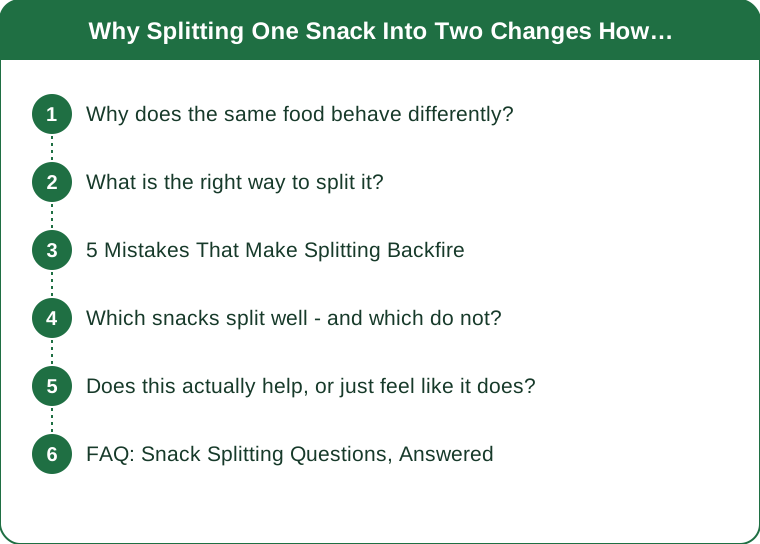
Why does the same food behave differently?
Fullness signals take about 20 minutes to register. Hormones like CCK and GLP-1 rise after food reaches the small intestine, so eating quickly means the signal arrives after you have finished and provides no guidance while you eat.
Splitting gives you two of those signal curves. The first snack triggers a response that begins fading around the 90-minute mark; the second arrives just as it does, extending the covered window rather than stacking on top.
Blood sugar follows the same logic. One larger snack produces a higher rise and a correspondingly sharper fall, and the fall is what registers as sudden hunger. Two smaller ones produce two gentler curves.
Gastric emptying rate is roughly proportional to volume, so a large snack empties faster in absolute terms than the equivalent split into two. Two smaller volumes spend proportionally longer in the stomach.
And the psychological effect is genuinely measurable. Studies on eating occasions consistently show that the perception of having eaten influences reported fullness independently of the amount - which is why two eating events beat one identical-sized event.
What is the right way to split it?
Roughly half and half, 90 minutes to 2 hours apart. That interval matches the point where the first snack’s satiety signal starts declining.
Put the protein and fat in the first half. These slow gastric emptying and drive the longest-lasting fullness. Front-loading them extends the first window so the gap before the second is comfortable.
Put the carbohydrate-heavier half second. By then you want a quicker response, and the second portion has less time to cover before your next meal.
Physically separate them. Two containers, or one left at your desk and one in a bag. A single open packet you intend to eat half of is not a split - it is one snack with a pause, and the pause rarely survives.
Pick the timing from your actual slump, not the clock. If you flag at 3:30, the first half goes at 2:30 and the second at 4:00. Working backward from the problem beats a fixed schedule.
And two is usually the limit. Splitting into three or four leaves each portion too small to trigger a meaningful satiety response, and it turns into continuous grazing - which is the failure mode this is meant to avoid.
5 Mistakes That Make Splitting Backfire
1. Making the first half too small to register. Below roughly 100 calories, the satiety response is weak and you get the interruption without the benefit. If the total is small to begin with, do not split it.
2. Keeping the rest visible. A half-eaten packet on the desk is a continuous decision, and continuous decisions get made badly at 3pm. Out of sight, in a container, in a drawer.
3. Splitting something that was never satisfying. Two halves of a food that leaves you hungry is two disappointments. Fix the composition first - protein plus fibre plus some fat - and split second.
4. Eating both halves standing up or at a screen. Distracted eating substantially reduces the perceived eating occasion, which is the mechanism you are relying on. Sixty seconds of attention per half is enough.
5. Waiting too long between halves. Past about three hours, the first half’s effect has fully gone and the second is just a separate snack. The window is the whole point.
And the bonus mistake: splitting when the real problem is the meal before. If lunch was 300 calories of mostly carbohydrate, no snack strategy will cover the afternoon. Splitting is a refinement, not a repair.

Which snacks split well - and which do not?
Nuts split perfectly. Portion them into two small containers - and this is one of the few foods where portioning matters enormously anyway, since eyeballing nuts is notoriously inaccurate.
Yoghurt with toppings works well. Plain yoghurt first with the protein doing the work, fruit and granola second when you want a faster response.
Fruit plus a protein source is the classic pairing to split. Cheese or nut butter first, the fruit an hour and a half later.
Anything that goes soggy or oxidises does not split well. Sliced apple, anything dressed, anything crisp with something wet. Practicality beats theory here - a second half you do not want to eat is not a strategy.
A protein bar is awkward but workable if you wrap the second half properly. Bars are usually engineered to be eaten in one go, so the split feels artificial, but the effect still applies.
And hot drinks are worth mentioning alongside. A warm drink with the first half adds volume and a genuine pause, and it costs nothing. As the weather cools this becomes an easier habit than it was in August - which is a good moment to build it.
Does this actually help, or just feel like it does?
The mechanisms are real, but the effect size is modest. Splitting a snack will not transform an afternoon of genuine undereating. It reliably smooths a mild slump; it does not replace an adequate lunch.
It works best for a specific pattern: the person whose lunch is reasonable but whose afternoon runs long, and who ends up eating dinner in a state of urgency. That is the case it fits.
It is less useful if you are hungry all afternoon, which usually indicates total intake is too low or too low in protein. Splitting a small amount into two smaller amounts makes that worse, not better.
Test it properly. One week normal, one week split, noting only what time you first feel hungry after the snack. One number, and it removes the guesswork.
Watch for it becoming grazing. If the split drifts into four small nibbles and then continuous picking, stop and go back to one snack - that outcome is worse than where you started.
And if hunger has changed markedly for no clear reason - much more or much less than usual, with weight change, fatigue, or thirst - that is worth a professional conversation rather than a snacking strategy. This is general information, not medical advice.
FAQ: Snack Splitting Questions, Answered
How far apart should the two halves be?
Ninety minutes to two hours. That is roughly when the first half’s satiety signal begins to fade, so the second extends the window rather than overlapping it.
Should both halves be the same food?
Not necessarily. Protein and fat first for longer-lasting fullness, carbohydrate-heavier second when you want a faster response, is the more effective arrangement.
Does this work for a small snack?
Not well. Below roughly 100 calories per half, the satiety response is too weak to register and you get the interruption without the benefit.
Can I split into three or four?
Generally not worth it. Each portion becomes too small to trigger a meaningful response, and it tends to slide into continuous grazing.
Is this just a trick to eat less?
No - the total is the same. The point is coverage across a longer window, not restriction.
Why does eating at my desk make it less effective?
The perception of having eaten is part of the mechanism, and distracted eating weakens it. A minute of attention per half is enough to keep the effect.
TL;DR:
- Two eating occasions produce two satiety curves, two gentler blood sugar responses, and two perceived eating events - from identical food.
- Split roughly in half, 90 minutes to 2 hours apart. That interval is when the first half starts fading.
- Protein and fat first, carbohydrate-heavier second.
- Physically separate them. An open packet you intend to half-eat is not a split.
- Do not split anything under about 200 calories total, and do not split into more than two.
- Sixty seconds of attention per half - distracted eating weakens the mechanism you are relying on.
If you are hungry all afternoon, the problem is lunch, not the snack. Splitting is a refinement, not a repair. This is general information, not medical advice.
Keep Reading
This article is for general informational purposes only and is not medical advice. Always consult a qualified health professional for guidance specific to you.