Why the Snack You Eat Standing Up Does Not Register as Eating
Quick Answer: Fullness is not purely chemical. Memory of eating contributes to how satisfied you feel afterwards, and food eaten while standing, distracted, or in motion is encoded poorly. Studies of distracted eating consistently find that people eat more at the next meal, and that memory of the previous meal predicts later intake. The standing snack delivers the calories and skips the part that makes you feel you have eaten.
It is not a willpower problem. It is an attention problem, and attention is easier to change.

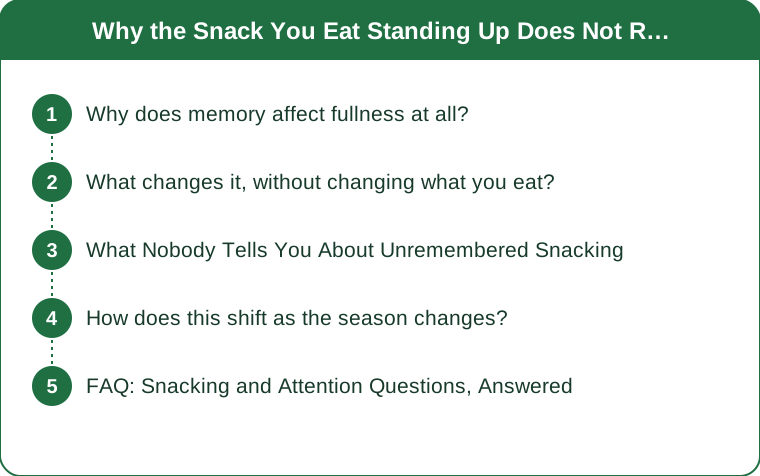
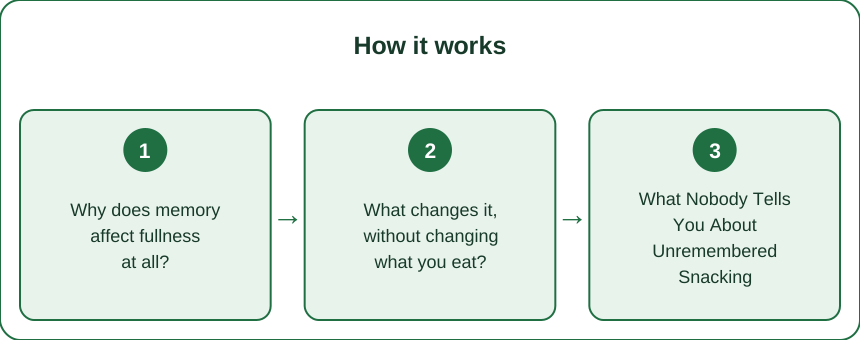
Why does memory affect fullness at all?
Because satiety is assembled from several signals, and recall of eating is one of them.
The obvious signals are physical: stretch receptors in the stomach, hormonal responses to nutrients arriving. Those happen whether you notice or not. But researchers studying memory and appetite have repeatedly found that what you remember eating influences how hungry you are later, sometimes to a surprising degree.
The experimental findings are striking. People with impaired memory can be given a second lunch shortly after a first and eat it readily. People who eat while watching television or playing a game eat more at a later meal than people who ate the same food attentively. And prompting people to recall their last meal before offering a snack reduces how much they take.
The practical reading is that eating creates a record, and the record does part of the work. No record, less effect.
Standing at the counter is a near perfect way to prevent the record forming. There is no location cue, no clear beginning or end, no plate, and usually something else occupying attention — a phone, a conversation, unpacking a bag. The episode has nothing to attach itself to.
There is also a duration effect. Eating quickly outpaces the hormonal fullness signals, which take a meaningful number of minutes to register. A standing snack is nearly always a fast one.
So you get the intake without the accounting, twice over.
What changes it, without changing what you eat?
Five things, and none of them are about restriction.
Sit down, even for three minutes. The most effective single change, and the least demanding. Sitting creates a start and an end, which is most of what the episode needs to be remembered.
Put it on a plate or in a bowl. Eating from the packet removes the portion boundary and the visual record simultaneously. The empty plate is itself evidence, and there is research suggesting visible evidence of what you have eaten reduces how much you go on to eat.
Give it your attention for the first minute. Not an entire mindful ritual, which almost nobody sustains. The first few bites carry most of the pleasure anyway, because sensory response declines as you keep eating the same thing. Attending to those specific bites is high return.
Separate it from the transition. Most unremembered snacking happens at a doorway, coming in, dropping bags, before doing the next thing. Deciding to snack after you have put things down and sat down, rather than during, converts almost all of it.
Do not eat directly from a screen. Television and phone eating is the best evidenced version of this whole effect. If the snack accompanies a screen, at least portion it first.
And one thing that helps at the other end of the day: recall what you ate before deciding what to eat next. It sounds like a therapy exercise and it has actual experimental support behind it.

What Nobody Tells You About Unremembered Snacking
It is worst when you are tired, and tiredness is also when it happens most. Poor sleep raises appetite and lowers the attention available to notice eating, which is a bad combination arriving simultaneously.
The kitchen doorway is the highest risk spot in the house. Not the sofa, not the fridge. The transition point where you arrive, still holding things, with nothing decided.
Variety extends it. Sensory specific satiety means enjoyment of one flavour declines while enjoyment of a different flavour does not. A single snack ends naturally; a spread of three different things does not, which is why grazing across several packets goes further than you meant.
It is not about hunger for most people, most of the time. Standing snacks are usually triggered by arrival, boredom, or a task boundary. This is worth knowing because hunger based fixes, more protein, bigger lunch, help less than expected if the trigger is a doorway.
Calling it a snack rather than food changes how it is counted. People consistently underestimate what they ate when the food was not part of a meal, and the label is part of why.
Slow eaters report more fullness from the same food. The hormonal signals need time to arrive, and standing eating is fast eating almost by definition.
The fix is one that removes nothing. You still eat the snack. It just registers, which usually means the next one arrives later.
How does this shift as the season changes?
It intensifies, and the reasons are worth planning around because the change happens over just a few weeks.
Darker afternoons pull the whole pattern earlier. For many people the reliable unremembered snack is the one at the door after work, and as it gets dark before that arrival, the day feels longer and later than it is. The same snack shifts from an occasional thing in July to a daily one by October.
Autumn routine changes add transitions. School restarts, activity schedules, more driving, more arrivals and departures. Every transition is a candidate moment for a standing snack, and the number of them per day rises noticeably at this time of year.
Comfort food arrives with the cold. Warmer, denser, more satisfying foods are a genuinely good thing, and they are also easier to eat quickly and forget while standing over the stove.
Specific adjustments that work:
Build a real afternoon eating point rather than resisting one. A planned sit down snack at four thirty prevents three unremembered ones between five and seven, and it removes the willpower question entirely.
Deal with the arrival trigger directly. Coat off, bag down, sit for three minutes with the snack. The whole intervention is thirty seconds of extra effort.
Watch for kitchen tasting while cooking. Genuinely one of the least recorded forms of eating there is, and cooking hours go up as the weather cools.
Use the seasonal advantage. A hot drink and something warm eaten sitting down is more appealing in autumn than in summer, so the sit down version becomes easier to sustain exactly when you need it.
This is general information about eating habits, not advice for anyone managing a specific medical condition or an eating disorder. If eating patterns are causing you distress, or if you are managing diabetes or another condition where intake matters clinically, a doctor or a dietitian is the right place to take it.
FAQ: Snacking and Attention Questions, Answered
Does eating slowly actually make a difference?
Yes, consistently in the research. Fullness signals take a meaningful number of minutes to register, and eating faster than that means you finish before the signal arrives. Slow eaters report more fullness from identical meals.
Is it bad to snack at all?
No. Snacking is neutral, and for a lot of people it is genuinely useful. The issue here is specifically eating that does not register, which tends to lead to more eating later rather than less.
Why do I do this most in the late afternoon?
A combination of a genuine energy dip, a long gap since lunch, and a high number of transitions in that part of the day. A planned afternoon snack, eaten sitting down, addresses all three at once.
Does putting it on a plate really change anything?
It creates a portion boundary and a visible record of what you ate, both of which have research support. It is a small action with a disproportionate effect, largely because eating from packets removes both.
TL;DR:
- Fullness depends partly on remembering that you ate, and standing, distracted snacks are encoded poorly.
- Distracted eaters consistently eat more at the next meal, so the unremembered snack tends to add rather than replace.
- Sit down, use a plate, and give the first minute your attention — none of it requires eating less.
- Autumn adds transitions and darker afternoons, so build a planned sit down snack before the pattern establishes itself.
Tomorrow, take the snack to a chair. Three minutes seated is the entire intervention.
Keep Reading
This article is for general informational purposes only and is not medical advice. Always consult a qualified health professional for guidance specific to you.